RollXO licence, trust and reputation in Australia
 Available in AU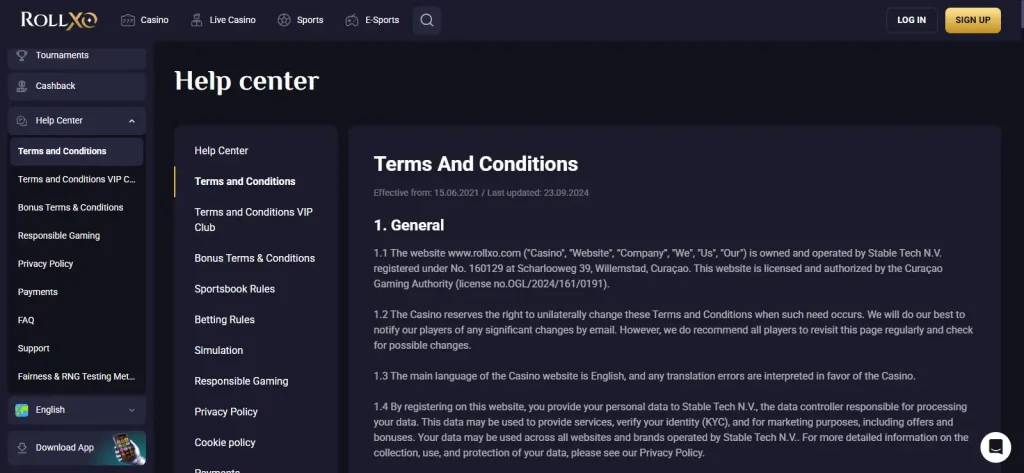
Licence and source quality
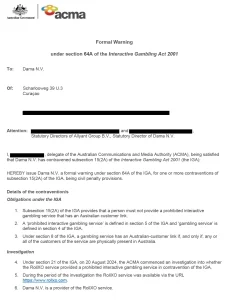
RollXO’s current official terms name Stable Tech N.V. as the operator and state that the site is licensed by the Curaçao Gaming Authority under licence OGL/2024/161/0191. No Australian local licence has been verified for RollXO. Those facts should be read separately: a Curaçao licence is a claim about the operator’s stated offshore licensing jurisdiction, while Australian authorisation is a different question governed by Australian law and ACMA. ACMA’s 2024 enforcement history includes RollXO and names Dama N.V. in the formal warning issued in connection with the service. Current RollXO terms now name Stable Tech N.V.; without a source proving the corporate relationship, those entities should not be treated as interchangeable. The detailed Australian regulatory chronology is covered in the dedicated Australian regulation guide.
Table of Contents
- The current operator and licence claim
- No Australian local licence was verified
- ACMA's 2024 RollXO action is a primary regulatory signal
- Dama N.V. in 2024 and Stable Tech N.V. today should not be merged without evidence
- An evidence hierarchy is more useful than a single trust score
- What the Curaçao licence does and does not tell an Australian reader
- How to read complaint and reputation signals
- Account transparency matters, but it is a different trust question
- Questions to verify before relying on a casino trust claim
- Why source dates matter for RollXO
- Regulatory status and withdrawal experience should not be collapsed into one claim
- What a current licence check should record
- How to read RollXO licence and reputation signals from Australia
The current operator and licence claim
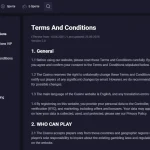
RollXO’s current terms identify Stable Tech N.V., registered in Curaçao, as the owner and operator of the site. The same official text says the website is licensed and authorised by the Curaçao Gaming Authority under licence number OGL/2024/161/0191. Current RollXO pages repeat that operator and licence wording in the footer.
Because the licence number is a high-risk factual detail, the current official wording is more reliable than an older review. The claim should also be stated precisely: RollXO says it is licensed by the Curaçao Gaming Authority. That is not the same as saying it has an Australian licence or is covered by Australian licensed-wagering protections.
The main RollXO Australia review summarises this distinction alongside the site’s product features. The focus is on weighing licence, regulator and reputation evidence without collapsing them into one label.
No Australian local licence was verified
ACMA maintains a register of licensed interactive wagering service providers for services that are licensed to operate in Australia. A current check does not provide a basis for claiming that RollXO is an Australian-licensed provider. The fact that RollXO has English-AU pages, supports AUD or presents a registration flow does not change that licensing question.
There is an additional structural point: online casino-style services and licensed interactive wagering are not the same regulatory category in Australia. ACMA explains that Australian law prohibits providers from offering certain interactive gambling services, including online casino-style services, to customers in Australia. A localised casino page therefore should never be used as a substitute for regulator evidence.
For detailed Interactive Gambling Act and ACMA context, see ACMA and Australian regulation. That guide carries the chronology so this page can stay focused on evidence quality and trust signals.
ACMA’s 2024 RollXO action is a primary regulatory signal
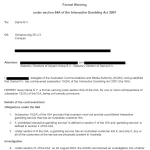
ACMA reported that it requested Australian internet service providers to block RollXO in November 2024 after finding listed services in breach of the Interactive Gambling Act. ACMA’s later enforcement report also records a formal warning to Dama N.V. for providing a prohibited interactive gambling service identified as RollXO.
This is materially different from a negative review. A regulator publication is primary evidence of the enforcement action described in that publication. It does not, by itself, answer every question about the current website, individual payments or the corporate history after that date, but it should carry more weight than anonymous comments when discussing Australian regulatory status.
The formal warning is especially useful because it identifies the investigated service, the relevant law and the entity ACMA treated as provider at that time. It should be described as historical regulatory evidence from 2024 rather than silently rewritten into a current operator statement.
Dama N.V. in 2024 and Stable Tech N.V. today should not be merged without evidence
The operator names create an important source-reading issue. ACMA’s 2024 formal warning names Dama N.V. as provider of the RollXO service during its investigation. RollXO’s current terms name Stable Tech N.V. as the current owner and operator.
Those two statements can both be reported because each is tied to a dated source. What should not be added is an unsupported explanation that Dama N.V. became Stable Tech N.V., that one acquired the other, or that the entities are legally the same. The available evidence used for this site does not establish that corporate continuity.
The accurate wording is therefore time-specific: ACMA’s 2024 action named Dama N.V.; current RollXO terms name Stable Tech N.V. This is a good example of why a trust review should preserve dates and source roles rather than smoothing an apparent discrepancy into a story that has not been verified.
An evidence hierarchy is more useful than a single trust score
| Evidence type | What it can establish | Main limitation |
|---|---|---|
| Current official RollXO terms | Current operator wording, stated Curaçao licence, account and policy rules | It is the operator’s own publication and does not prove Australian authorisation |
| ACMA register and enforcement publications | Australian licensed-wagering register context and documented regulatory action | Regulator records answer defined legal and enforcement questions, not every service-quality question |
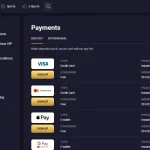
| Payment and account terms | Published rules for KYC, withdrawals, account use and payment handling | Policies do not predict the outcome or timing of every individual case |
| User reviews and complaint posts | Recurring user concerns and topics worth investigating | Individual accounts can be incomplete, unresolved or impossible to independently verify |
| Affiliate or review sites | Secondary comparison and discovery signals | Commercial incentives and stale facts can affect reliability |
This hierarchy does not mean every primary source is automatically favourable to the operator. It means the source should be matched to the question. The regulator is the stronger source for Australian enforcement; RollXO’s own current terms are the stronger source for what RollXO currently says about its operator and policies.
What the Curaçao licence does and does not tell an Australian reader
The stated Curaçao licence establishes the jurisdiction RollXO currently identifies for its gambling authorisation. It is relevant when checking who the operator says regulates the casino and whether the licence wording is internally consistent across current pages.
It does not establish a local Australian licence, place RollXO on ACMA’s licensed interactive wagering register or imply access to Australian protections that apply to licensed wagering providers. Licensing jurisdictions should therefore be named rather than blended into a generic phrase such as “fully licensed in Australia”.
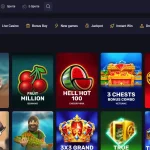
This separation is also important when reading promotional language. AUD support, Australian localisation, mobile access and casino features are product facts. They do not change the jurisdiction of the licence.
How to read complaint and reputation signals
Search results for online casinos often surface complaints about withdrawals, KYC, bonus restrictions or account closure. Those reports can be useful for identifying what users repeatedly ask about, but an individual post cannot prove how another account was handled. It may omit the account’s verification state, payment ownership, bonus conditions or later resolution.
Review stars, forum claims and complaint anecdotes should not be converted into a verdict such as “safe” or “scam”. Instead, a complaint topic should be checked against primary sources where possible. If users complain about KYC, compare the issue with the current verification terms. If they complain about a withdrawal, compare the account facts with the published withdrawals.
Patterns can justify further investigation. They should not replace evidence of a specific regulatory action, licence statement or transaction outcome.
Account transparency matters, but it is a different trust question
RollXO publishes terms, a privacy policy, payment rules and account requirements. Those materials give users something concrete to inspect before registration and can be checked against the live account experience. The account guide explains how currency, identity and account rules fit together.
Publishing terms does not erase regulator history, and regulator history does not tell you the outcome of every ordinary support or payment interaction. Trust analysis becomes clearer when these layers remain separate: corporate and licence identity, Australian regulatory status, current account rules and account-specific service performance.
A single star rating tends to hide those distinctions. A source-by-source review makes it possible to say exactly which part is documented and which part remains an individual experience.
Questions to verify before relying on a casino trust claim
- Who is named in the current terms? For RollXO, the current official operator wording names Stable Tech N.V.
- What licence jurisdiction and number are stated? RollXO currently states Curaçao Gaming Authority licence OGL/2024/161/0191.
- Is there a verified Australian licence? Do not infer one from AUD, localisation or registration access.
- Has ACMA published enforcement material? Yes, ACMA’s 2024 materials document action involving RollXO.
- Are historical and current operator names being kept separate? ACMA named Dama N.V. in the 2024 action, while current terms name Stable Tech N.V.
- Is a complaint being treated as an allegation or as proven account history? Keep anecdotal evidence in its proper category.
- Are current policies being checked at the time they matter? Licence, KYC, bonus and withdrawal terms can change.
These checks do not produce a universal trust score. They produce a clearer factual record from which a reader can make their own assessment.
Why source dates matter for RollXO
RollXO is a useful example of why undated summaries can mislead. The ACMA enforcement material is tied to 2024 and names Dama N.V. The current RollXO terms available in 2026 name Stable Tech N.V. and display a Curaçao Gaming Authority licence number. Removing the dates can make those sources look contradictory when they actually describe different points in time.
Current checks are especially important for licence numbers and operator names because they are high-risk details. Current official RollXO terms support the present operator/licence claim, while ACMA primary material supports the historical Australian enforcement record.
If either source changes, the appropriate response is to update the specific claim, not to rewrite unrelated facts about games, payments or bonuses.
Regulatory status and withdrawal experience should not be collapsed into one claim
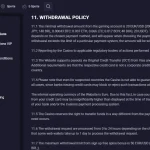
A user deciding whether to trust an operator may naturally connect regulation with payment experience, but the evidence should still be kept distinct. ACMA enforcement demonstrates a regulatory fact. RollXO’s withdrawal terms demonstrate published account rules. A user’s pending cashout demonstrates only that user’s current transaction state unless more evidence is available.
This is why the withdrawal page and trust page link to each other but do not substitute for each other. If the question is why a specific payment is pending, use the account and withdrawal evidence. If the question is who operates the site and what Australian regulators have done, use licence and ACMA sources.
Keeping those questions separate reduces both overstatement and false reassurance.
What a current licence check should record
A useful licence check should record the operator name, the licence jurisdiction and number exactly as shown, the date the source was checked, and whether the claim comes from the operator or a regulator. For Australian status, it should separately record the result of the ACMA register and any relevant enforcement publication. Keeping those fields separate makes later updates easier: if the operator name or Curaçao licence wording changes, that specific record can be refreshed without rewriting the historical ACMA material. It also prevents a current offshore licence statement from being mistaken for local Australian authorisation.
Trust signals are strongest when each one answers a specific question. The operator’s terms can show what the site currently says about ownership and licensing, while ACMA material records the Australian enforcement history. Payment rules can explain withdrawal and verification conditions, but they do not replace regulator information. Keeping those source roles separate makes it easier to spot when an older claim, a complaint or an offshore licence is being asked to prove more than it actually can.
How to read RollXO licence and reputation signals from Australia
The documented picture has several distinct parts: current RollXO terms name Stable Tech N.V. and state Curaçao Gaming Authority licence OGL/2024/161/0191; no Australian local licence has been verified; and ACMA’s 2024 enforcement material records action involving RollXO and names Dama N.V. in the formal warning. Those facts should be reported with their dates and source roles intact, without guessing at the relationship between historical and current operator entities. User reviews and complaints can highlight questions worth checking, but they should not replace regulator records or current terms. For the Australian legal chronology and ACMA framework, continue to the dedicated regulation page rather than treating an offshore licence as local authorisation.
Official references: RollXO Terms & Conditions and ACMA enforcement report.