RollXO payment methods for Australian accounts
 Available in AU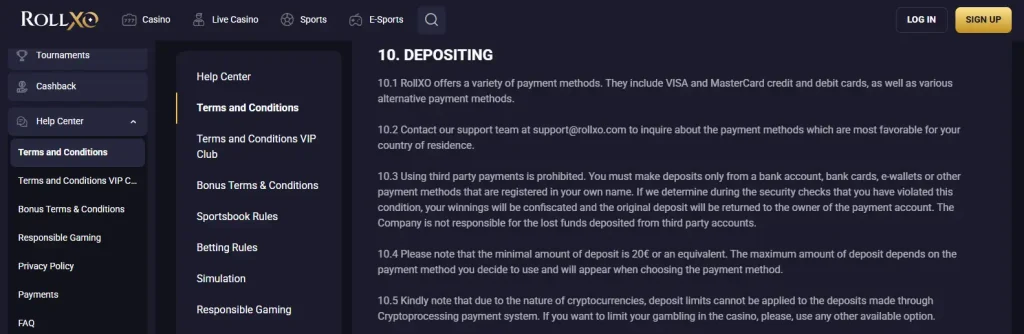
Australian payments guide
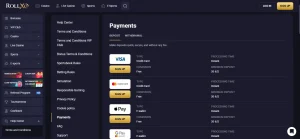
RollXO supports AUD as an account currency and its broader payment setup includes bank cards, e-wallets and cryptocurrencies. That does not mean every method shown globally will appear for every Australian account: RollXO’s own terms say payment choices are country-specific and direct players to the cashier or support for the options available to their residence. For Australians, this distinction matters because cards and PayID are familiar local payment habits, but PayID is not established as a RollXO method in the current official information. The practical approach is to treat AUD support as confirmed, payment categories as confirmed, and the exact method list in your own cashier as the source of truth before depositing or withdrawing.
Table of Contents
- What is verified about RollXO payments in Australia
- AUD support reduces one layer of friction
- Cards are familiar in Australia, but issuer approval still matters
- PayID is locally relevant but not a verified RollXO method
- E-wallets can separate casino and bank details
- Crypto support is real, but it is not the dominant Australian payment habit
- Deposits and withdrawals should be evaluated separately
- What to check in the cashier before moving money
- Australian payment habits versus RollXO's verified method set
- Which RollXO payment options are most practical for Australian accounts
What is verified about RollXO payments in Australia
The strongest verified point is currency support. RollXO’s current AU terms list AUD among the accepted currencies. The same official terms describe deposits from a player’s own bank account, bank card, e-wallet or other supported payment method, and separately publish cryptocurrency currencies including BTC, ETH, LTC, BCH, DOG, USDT, BNB, ADA and TRX. Independent payment reviews also corroborate that the broader product supports cards, e-wallets and crypto.
The important limit is availability. RollXO states that payment methods are country-specific and that the maximum deposit or withdrawal amount can depend on the selected method. That means a method appearing in a general review, global list or older secondary material should not automatically be labelled available for every Australian account. The current cashier is more useful than a generic list because it reflects the account, selected currency, country and payment processor combination presented at that moment.
| Payment point | What is verified | What still needs an account-level check |
|---|---|---|
| Account currency | AUD is accepted | Any provider-side conversion or card issuer treatment |
| Cards | Card payments are supported in the broader product | Which card rails are shown for the Australian account |
| E-wallets | E-wallet support exists | Which wallet brands are currently offered |
| Crypto | Multiple cryptocurrencies are supported | Which crypto methods appear in the live cashier |
| PayID | Locally important in Australia | Not verified as a RollXO method |
AUD support reduces one layer of friction
For an Australian user, an AUD-denominated account is easier to read than an account displayed only in euros or US dollars. Deposits, balances and stake sizes can be viewed in the same currency most Australians use for everyday budgeting. That does not remove every conversion issue, because a card issuer or payment processor can still apply its own treatment, and RollXO’s terms say the website’s internal operating currency is euro. It does mean the public product explicitly recognises AUD rather than requiring the reader to invent a converted account balance.
This matters most when comparing payment choices. If two methods are available but one creates a provider-side conversion while another settles directly in AUD, the apparent deposit amount may not be the whole cost. The correct comparison is the final amount shown by the cashier and payment provider, not a conversion estimated from a search engine exchange rate.
RollXO’s bonus terms also use fixed currency equivalents for some promotional rules. Those equivalents are casino-defined rather than live foreign-exchange rates. The same caution therefore applies when a promotion, minimum or limit is expressed in another currency: use the AUD figure shown by RollXO when one is provided rather than creating a new conversion.
Cards are familiar in Australia, but issuer approval still matters
The Reserve Bank of Australia’s 2025 Consumer Payments Survey found that cards accounted for 73% of Australian consumer payments and debit cards alone accounted for 49%. That helps explain why card funding is a natural reference point for Australian users. RollXO’s terms support card-based payments in the broader product and describe Visa and Mastercard payout mechanisms under certain conditions.
However, familiarity does not guarantee acceptance. RollXO explicitly notes that banks can block or reject card transactions even in supported countries. A card can therefore be a technically supported category while a particular issuer, card type or transaction is declined. This is one reason the cashier should be checked before relying on a card as the only funding route.
Third-party payments are another boundary. RollXO’s terms require deposits to come from a payment account registered in the player’s own name. That is more important than whether the card or wallet itself is popular. Using another person’s card or payment account can create verification and withdrawal problems later because the payment ownership trail no longer matches the casino account.
PayID is locally relevant but not a verified RollXO method
PayID has become a mainstream Australian transfer tool. Around half of respondents in the RBA’s 2025 Consumer Payments Survey reported using PayID during the previous year. That makes it reasonable for Australian readers to look for PayID when comparing casino payment pages.
But local popularity is not evidence that RollXO supports it. Current RollXO terms and payment information do not establish PayID as an Australian cashier option. PayID should therefore not be listed as available at RollXO without current cashier evidence.
If PayID appears in the live cashier, the account-level interface would be the relevant evidence for that session. Until then, PayID is best treated as an important Australian payment method that is not currently established here as a RollXO option.
E-wallets can separate casino and bank details
RollXO supports e-wallets as a broad payment category. For some users, an e-wallet can create a clear separation between the casino transaction and the everyday bank account. The practical question is not whether e-wallets exist on RollXO globally, but which wallet brands the Australian cashier currently exposes and whether the same wallet can be used for both deposit and withdrawal.
Matching the deposit and withdrawal route where possible can simplify the transaction history reviewed during verification. RollXO also reserves the right to transfer funds through a method different from the one requested when necessary, so a deposit method should not be treated as a guarantee of an identical cashout route.
Before using an e-wallet, check the wallet’s own fees, verification status and account name. A wallet registered to someone else creates the same third-party payment problem as another person’s bank card. The casino’s terms focus on ownership, not just the payment logo.
Crypto support is real, but it is not the dominant Australian payment habit
RollXO supports several cryptocurrencies and explicitly includes crypto-denominated account options. That makes crypto a genuine part of the product rather than a speculative feature. At the same time, Australian consumer-payment data gives useful scale: only about 2% of respondents in the RBA’s 2025 survey reported using cryptocurrency to make a payment in the previous year.
The contrast is useful. Crypto may be prominent in offshore casino marketing while remaining a niche everyday payment behaviour in Australia. Users who already hold crypto may value the option, but someone who normally transacts in AUD should not assume that converting funds into crypto is automatically simpler or cheaper.
Crypto also has different operational characteristics. Blockchain transfer fees, confirmation times, asset volatility and wallet-address accuracy sit outside the normal card experience. RollXO’s terms additionally state that the casino does not provide fiat-to-crypto exchange services. If an Australian user chooses crypto, the conversion into or out of the asset happens elsewhere and introduces a separate decision from the casino payment itself.
Deposits and withdrawals should be evaluated separately
A method that is convenient for funding is not necessarily the best guide to cashing out. Deposit pages answer questions such as minimum funding amount, account ownership and method availability. Withdrawal pages add verification status, payout routing, method limits and processing rules.
For that reason this overview does not turn every payment-method detail into a single table of “fastest” or “best” options. The evidence needed for those rankings is account-specific and changes over time. For funding mechanics, continue to our AUD deposits guide. For cashout rules, KYC dependencies and current official policy, see withdrawals in Australia.
Keeping those intents separate also prevents a common error: taking a deposit minimum and presenting it as a withdrawal minimum, or assuming a method that accepts deposits automatically accepts payouts. RollXO’s own terms treat depositing and withdrawal as separate sections, which is the safer structure for readers as well.
What to check in the cashier before moving money
- Confirm the account is set to AUD if that is the currency you intend to use.
- Read the exact deposit or withdrawal methods currently displayed for the account rather than relying on a generic global list.
- Check the name on the bank account, card or e-wallet matches the RollXO account holder.
- Review the amount shown by the payment provider before confirming, especially if a currency conversion is involved.
- Do not assume PayID is available unless it is actually displayed in the cashier.
- If using crypto, verify the network, asset and wallet address independently before sending funds.
- For a withdrawal, confirm verification requirements first instead of assuming a successful deposit means cashout is immediately cleared.
New users should also review account setup because identity details entered at registration can later be compared with payment ownership and KYC records. For the wider regulatory context around an offshore operator serving an Australian-facing site, see licence and trust.
Australian payment habits versus RollXO’s verified method set
The RBA data makes one point clear: Australian consumers are heavily card-oriented, PayID has substantial usage, and crypto payments remain comparatively uncommon. RollXO’s verified payment picture is different in structure. It supports AUD plus broad categories of cards, e-wallets and crypto, while the exact Australian account-level methods can vary by country and processor.
That means local popularity should guide the questions you ask, not claims about RollXO availability. Cards are both locally common and supported as a RollXO category. PayID is locally common but not verified here as a RollXO option. Crypto is verified at RollXO but is not a mainstream Australian payment behaviour according to the RBA survey.
This separation produces a more useful comparison than a long logo list. It tells you which facts belong to the casino, which belong to the Australian payment market, and where a live cashier check is still necessary.
A payment method is useful only when its current account-level conditions are clear. Before funding the account, compare the currency, minimum and maximum shown in the cashier with the method you intend to use, then keep the transaction record until the balance has been credited correctly. The same habit makes later withdrawal questions easier to trace.
Which RollXO payment options are most practical for Australian accounts
Practicality depends on what the account actually offers, whether the method is in your own name, whether it settles cleanly in AUD and whether it can support the later withdrawal path. Cards are familiar to Australian consumers and are a verified RollXO category; e-wallets and crypto are also supported categories, while PayID should not be assumed without seeing it in the cashier.
The most reliable process is therefore simple: choose AUD where appropriate, open the current cashier, compare only the methods displayed to your account, check provider-side costs and ownership requirements, and then use the dedicated deposit or withdrawal guide for the next step.
Official references: RollXO AU Terms & Conditions and Reserve Bank of Australia consumer payment research.
For the broader context, see the RollXO Australia review.